Your Coffee Is Contracted. That Doesn’t Mean It Can Ship.
After the magnitude‑7.4 earthquake that hit western Colombia on 10 August 2026 and the days of restricted road and terminal access that followed (Associated Press), road closure and port diversion may push ETA from 4wks to 12wks.
Read on to map the full origin-to-roaster supply chain, identify where delays can compound, and decide whether to secure backup inventory, reallocate supply, or communicate shortages before they reach customers. Plus, a look at how Colombia’s major trading ports were affected following the 7.4-magnitude earthquake.
What happened in Colombia?
- 10 Aug 2026 — A magnitude‑7.4 earthquake struck western Colombia (Associated Press).
- In the days after the quake, road corridors to Buenaventura reported landslides, tunnel damage, and heavy‑truck restrictions; terminal inspections and appointment limits followed (local industry reporting).
- International carriers issued operational advisories and adjusted schedules; Maersk published an operational update and contingency coordination (Maersk).
- Exporters and trade bodies signaled large volumes at risk of temporary hold and explored reroutes to Caribbean ports (trade reporting).
Below is a verification checklist for your operation. For each contracted lot:
[ ] Get time‑stamped evidence of its physical location (mill, truck, terminal, stuffed container)
[ ] Confirm who holds the bill of lading, and whether any customs or administrative orders affect transit.
Why “contracted” is often mistaken for “available”
Commercial systems commonly count a purchase order or confirmed contract as “incoming inventory” and fold it into availability forecasts. That’s a commercial claim/title or promise of future delivery. It is not a guarantee the coffee is physically in a releasable state.
Key distinctions your roasting business must track:
- Commercial ownership (contract/PO)
- Physical control (coffee at mill, in truck, at terminal, stuffed)
- Releasable units (warehouse has paperwork and will hand pallets to your carrier)
Common system failures that hide status:
- ERPs that count “contracted” pounds as available stock in demand planning.
- Forwarder/ importer portals that show “booked” or “in transit” without which physical leg is delayed.
- Sales and roast plans built on optimistic system numbers rather than documentary evidence.
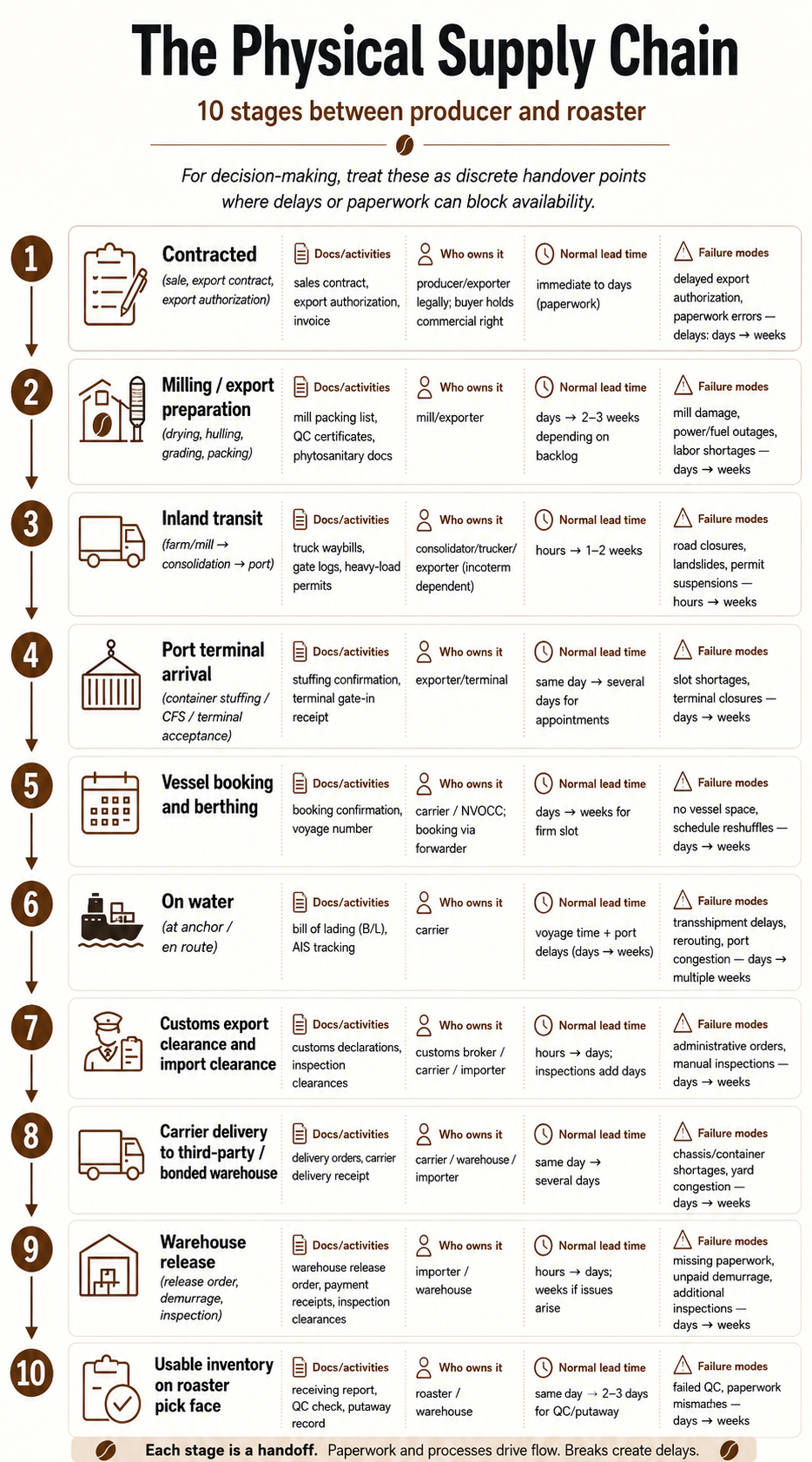
A single disruption (for example a road closure into a primary port) can cascade across stages 3, 4, 5 and 9, turning a one‑week delay into multiple weeks.
Operators should treat each handoff as verifiable with photos/documents. Require time-stamped mill packing lists, photos, truck manifests, terminal gate-in receipts, stuffing appointments, and confirmed vessel-booking references. Make sure to ask exporters and forwarders for contingency dates, alternate mills, alternate routes, and costed reroute scenarios including extra inland freight, terminal fees, re-stuffing, demurrage, and added transit time; and have brokers verify any customs or administrative restrictions by order number, source, expected duration, and remedy steps. The goal is to know exactly where the coffee is, whether it is truly moving, and what the fallback plan costs before one disrupted stage cascades into several weeks of delay.
To stay up to date, please be aware of Administrative Order No. 2518 and local conditions.
Verify physical stage, stress‑test your weeks of supply, and act inside the time window your customers can tolerate.
Selected sources and suggested follow‑up reading:
- Wei, D.; Rose, A.; Koç, E.; Chen, Z.; Soibelman, L. “Socioeconomic impacts of resilience to seaport and highway transportation network disruption.” Transportation Research Part D. 2022. DOI: 10.1016/j.trd.2022.103236.
- Associated Press. “Magnitude 7.4 quake rocks western Colombia” (10 Aug 2026).
- Maersk. “Colombia Earthquake: Operational Update” (11 Aug 2026).
- Industry reporting on Colombia port and inland impacts (Aug 2026).
Roast Radar