
When the Cupping Environment Changes What You Taste
Have you ever wondered if the environment around your cupping table may be part of the sensory test?
A new lab study shows brief, temporally aligned tactile cues (smooth vs. rough surfaces touched while sipping) change perceived acidity in blind, timed tastings. For teams that accept, reject, or price lots based on sensory differences, especially when samples are compared across days, people, or labs-the tasting environment is a plausible source of measurement noise and should be managed for high stakes decisions.
Kubo & Ariga (2026) report that the same black coffee tasted differently when participants experienced smooth versus rough tactile cues at the moment of sipping. The effect appeared when the tactile cue was on the cup sleeve or when participants touched a separate object with the opposite hand, and it disappeared when touch and sip were not simultaneous. The study used blindfolded participants under controlled sip timing; it tested acidity intensity. Note that the study itself did not prove changes in sweetness or aftertaste.
Why does this finding matters to your coffee business?
If sensory differences trigger acceptance, claim, or pricing decisions, uncontrolled tactile or environmental differences can turn a repeatable product into an irreproducible dispute. A single uncontrolled variable, different cup texture, a cardboard sleeve, a rough workbench, or a phone on the table can change perceived acidity enough to prompt commercial action. That matters when a claim or roast‑profile decision can be worth tens of thousands of dollars.
Where does this show up in operations/lab?
- Green purchasing (offer vs pre‑shipment): acceptance or negotiation based on sample attributes.
- Arrival vs pre‑shipment disputes: claims, discounts, and rejections.
- Roast development: tuning roast curves based on cupping feedback.
- Production QC and routine acceptance: any place where sensory scores become decisions.
Before escalation, run a controlled check: if a sensory difference persists in a blinded, randomized side‑by‑side that uses identical vessels and utensils, is observed by at least two calibrated evaluators, and reproduces in a repeat session on a separate day, treat the coffee as likely changed and escalate to contract/claims workflow. If the difference disappears under those controls, document the measurement variation and resolve operationally without immediate commercial penalties.
Study evidence (condensed version)
Experiment 1 (n=92): same coffee, cups with rough vs smooth sleeves; smooth sleeve → lower perceived acidity.
Experiment 2 (n=24): touching a separate smooth/rough object concurrently with sipping produced the same pattern.
Experiment 3 (n=48): effect vanished when touch and sip were not simultaneous.
DOI: 10.1163/22134808-bja10198. Full statistics are in the journal PDF; the paper was run in controlled lab conditions and the sample was limited to one coffee and a Japanese participant pool.
Kubo & Ariga (2026) found that tactile smoothness can reduce perceived coffee acidity, but only when touch occurs at the same time as tasting. Across three lab experiments, participants rated identical coffee as less acidic when touching a smooth rather than rough surface, even when the touched object was separate from the cup. The effect disappeared when touching and sipping were not simultaneous, suggesting a real-time crossmodal interaction between touch and taste.
Operationally, the takeaway is this: tactile and visual cues are a plausible source of measurement variance. Treat that risk proportionally, tighten controls for high‑value or disputed lots, and run pilots before changing every routine cupping practice.
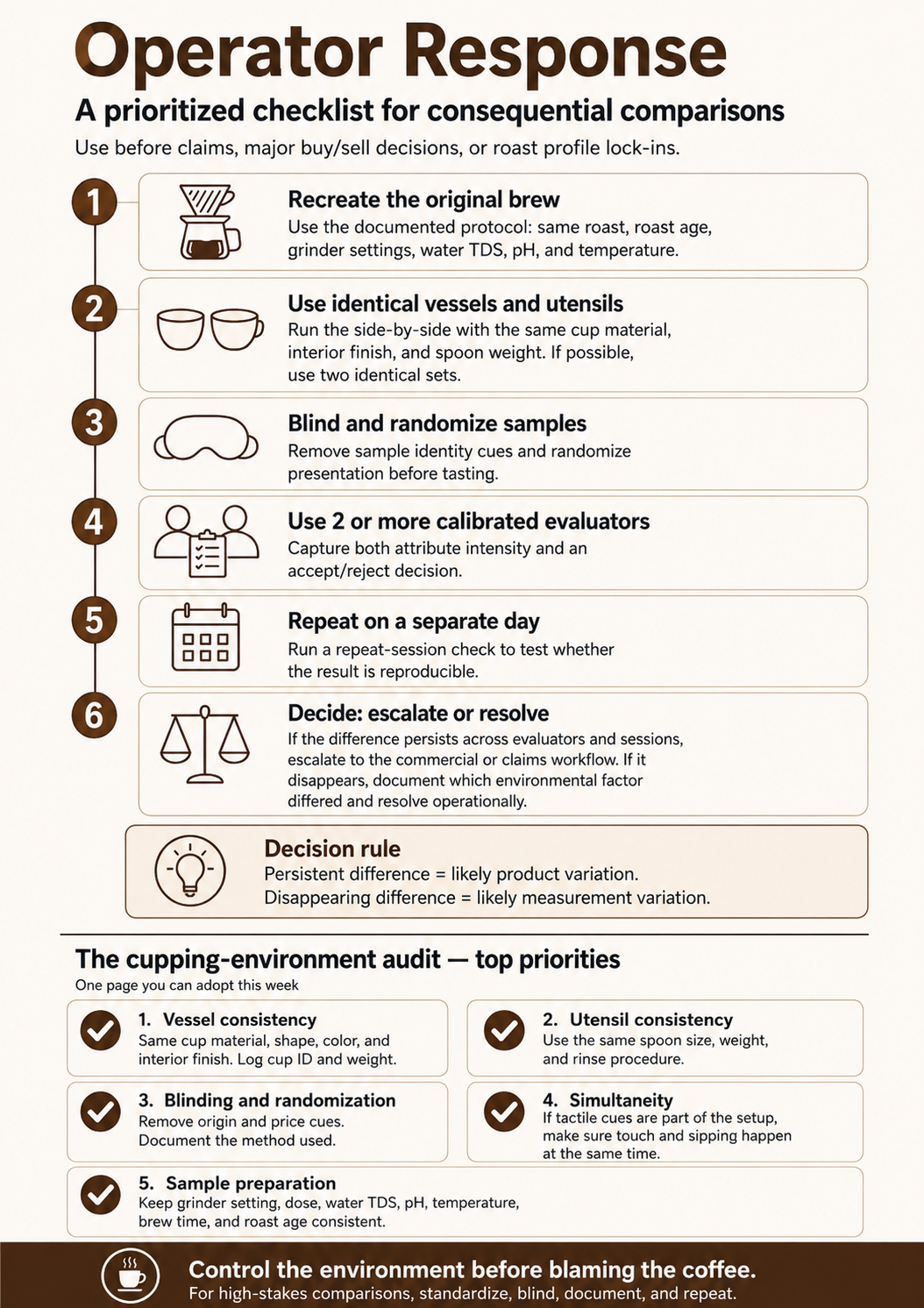
Try it yourself!
Pick one consequential comparison (e.g., pre‑shipment vs arrival) and run the full sequence above, logging audit fields and metrics. Report the results to buying and QC teams and decide whether to scale controls.
Sources:
- Kubo, N., & Ariga, A. The contextually tolerant but temporally intolerant sensation transference from tactile to taste in drinking coffee. Multisensory Research. Online 03 Jun 2026. DOI: 10.1163/22134808-bja10198.
- Carvalho, Moksunova & Spence. Cup texture influences taste and tactile judgments in specialty coffee. Food Quality & Preference (2019).
- Pramudya & Seo. Hand‑Feel Touch Cues - Foods (MDPI) 2019.
Roast Radar